Home / 1996-2026: CRP Technology Celebrates 30 Years of SLS 3D Printing
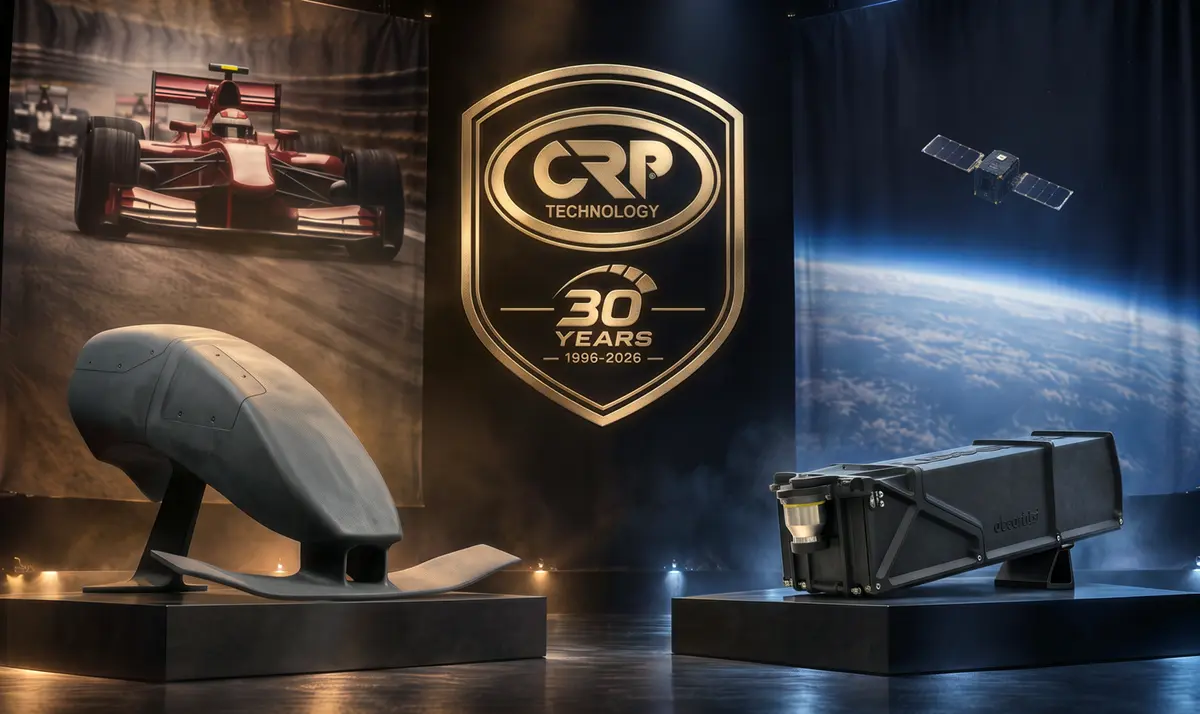
In 1996, long before 3D printing became a widely discussed industrial technology, CRP Technology began using selective laser sintering (SLS) in Modena, Italy. The company was the first in Italy and among the first in Europe to adopt the process. In 2026, it celebrates thirty years of SLS 3D printing: a history that reflects both the evolution of polymer additive manufacturing and the expertise built through decades of practical work.
By the time 3D printing came to wider public attention, CRP Technology already had years of SLS production experience behind it. A technology often described as new has been part of the company’s everyday manufacturing activities for three decades. The focus today is on what it takes to use it effectively in an industrial project.
Buying an SLS machine is one thing; developing the knowledge to use it well takes years of building parts, taking measurements and responding to application requirements. That knowledge comes from understanding how material, part geometry, build orientation and post-processing interact, and knowing which factors can affect component performance.
At CRP Technology, this experience shapes the feasibility assessment from the outset. What loads will the part need to withstand? Which surfaces will mate with other components? What conditions will it encounter in service? The answers help determine process choices, geometric features and finishing operations for each application.
Experience with SLS has also informed the development of proprietary materials. CRP Technology introduced the first Windform® materials in 1999, and material formulation and process expertise have evolved together ever since. Project requirements have helped shape the development of Windform® composite materials, while a deeper understanding of their properties has opened up new applications for the technology.
Today, the Windform® range includes twelve materials for SLS 3D printing. Choosing the right material involves more than comparing technical data sheets. Its properties need to be considered alongside part geometry, component function and the testing and verification required for the intended application.
Over thirty years, the role of SLS in the company’s projects has changed. From models and prototypes, CRP Technology has progressed to functional prototypes, low- to medium-volume production and selected end-use parts made from Windform® materials.
This progression can be seen in documented applications in motorsport, unmanned systems and space projects, including CubeSat programmes that have reached orbit. Across these different sectors, each component must be assessed against its intended function: the printing process alone does not establish whether a part is suitable for end use.
CRP Technology operates ten SLS systems in Modena, including a four-laser system with a build volume of 600 × 600 × 600 mm. Post-processing options include in-house vapor smoothing and, where required, CNC finishing by CRP Meccanica. The company is certified to EN 9100:2018 and ISO 9001:2015 for the activities covered by its certificate, and also holds ISO 14001:2015 certification.
The Windform® expertise developed in Modena also supports SLS production at CRP USA in North Carolina and CRP Gulf in Dubai. Machines, materials, customer requirements and applications have changed over time. What continues to connect them is the engineering judgement needed to match materials and processes to each application.
CRP Technology draws on those thirty years of SLS experience to meet today’s project requirements and prepare for the challenges ahead.