3D printed engine parts, an introduction
3D printed engine parts, when manufactured using a state-of-the-art additive technology and advanced composite materials, meet the most demanding needs of the fast-paced industry par excellence, the Motorsport.
From several years, CRP Technology is involved in the production of components with the Rapid Prototyping Technology for this industry indeed, whether it’s the four or two wheels sector.
These rapid prototypes are made by Laser Sintering Technology and Windform materials, developed by CRP starting from 1998.
There are several different fields of application for Windform XT (carbon filled material) and Windform GF (aluminium and glass filled), largely used by CRP Technology.
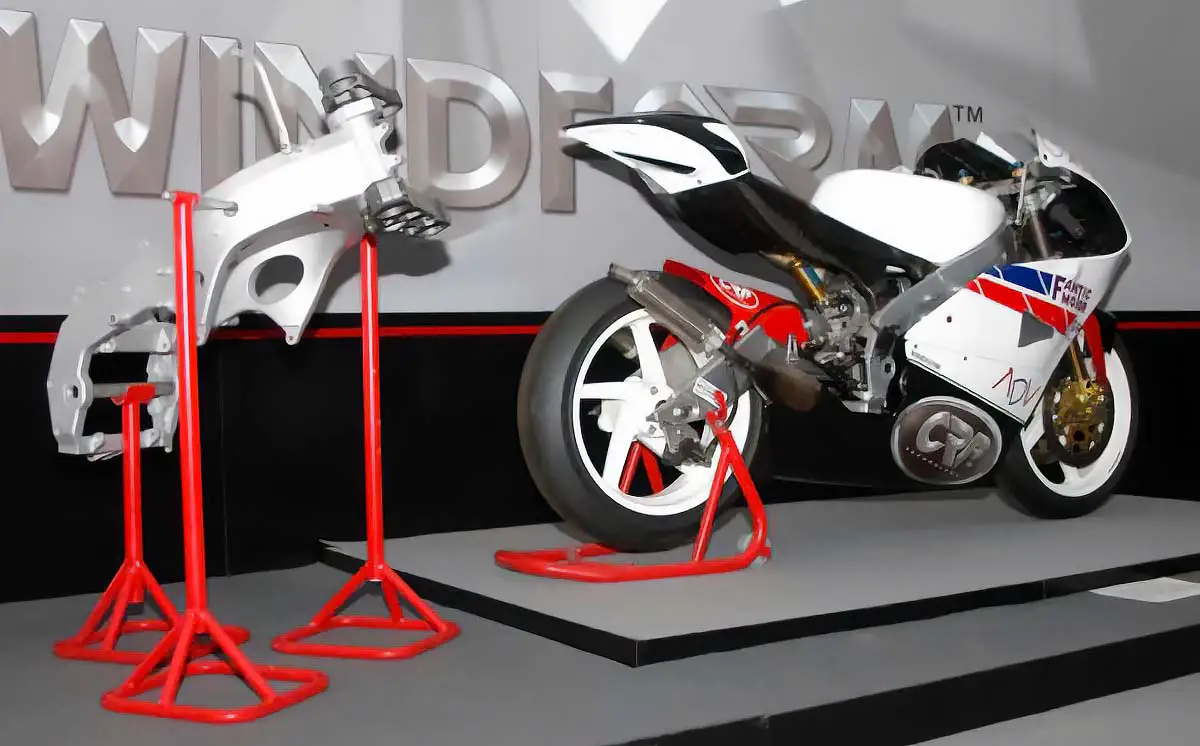
One of the most representative example of Direct Digital Manufacturing with Windform material is the development of the 250 cc Fantic Motorbike, that took part at the MotoGP 2005.
In 2005, the company began the great challenge of the racing motorbikes, facing the worldwide market with a MotoGP 250 cc class bike, completely built by the CRP technical staff and that has lined up at the World Road Championship 2 bikes with the Fantic Motor brand.
The project
Thanks to the top-level materials such as Windform GF and XT, it is now possible to use laser sintering for reliable and high performance parts ready to race.
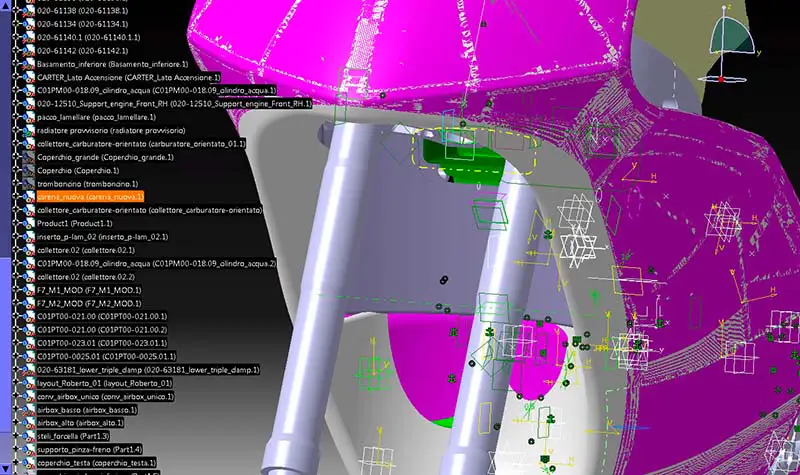
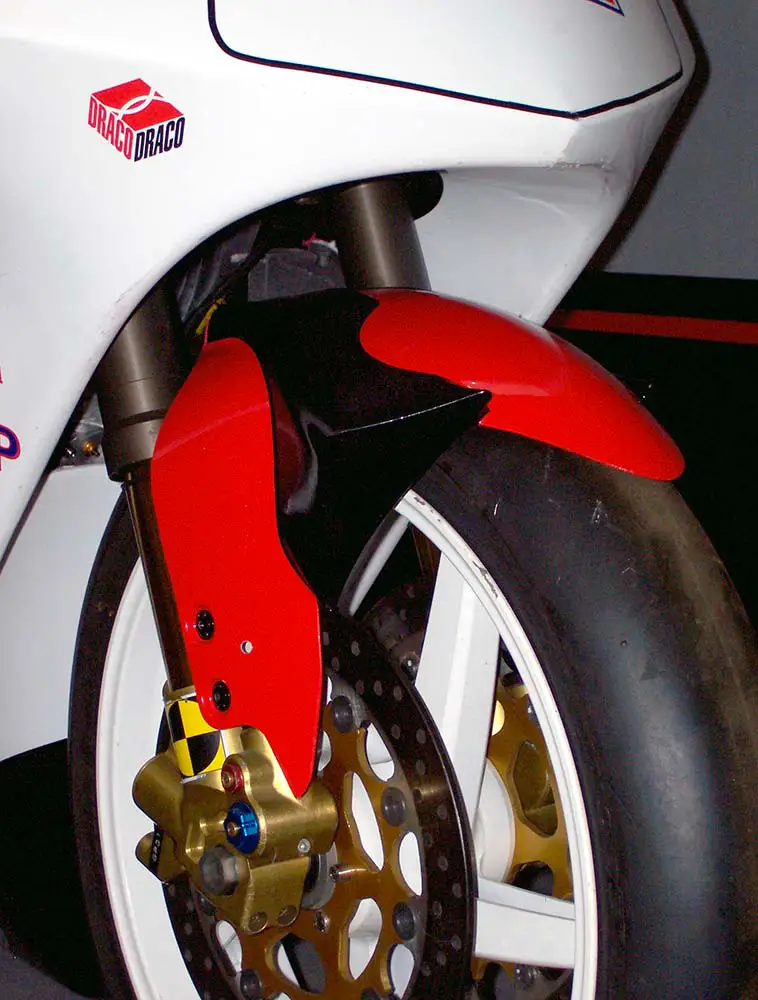
Everything has been focused on the case study of a new air box configuration made of Windform XT for the CRP R250 Engine, combined with a special carburettor insulator made of Windform GF; a new cowling for the CRP R250 made of Windform XT; a special front mudguard for the CRP R250, with integrated air ducts, made of Windform XT and a rear mudguard and rider seat for the CRP R250 made of Windform XT.
In F1, everything is about time, from reducing the time on the racing track, to reducing the time to deliver as many design iterations as possible.
“In wind tunnel a half-scale car is continuously tested in as many aerodynamic configurations as time permits. And then, the inevitable question — can you make parts that go on the actual car? The advantages would be immense, if we could take that precious next step.” (Steve Nevey, Red Bull Racing)
Windform XT suits exactly these requirements: perfect for wind tunnel, it can be used to make master models for carbon lamination (also in autoclave) and can be sintered for race car parts of course.
CRP used it in order to bring a completely new bike on the MotoGP race tracks within 6 months and is still using it for next seasons business.
It was the beginning of a great new challenge. During the 2005 season, the most evident gap consisted in the power output of the engine and that’s why most of the job has been focused on it in 2006.
CRP Technology worked on the development of the engine exploiting the Rapid Prototyping technology and the Windform materials.
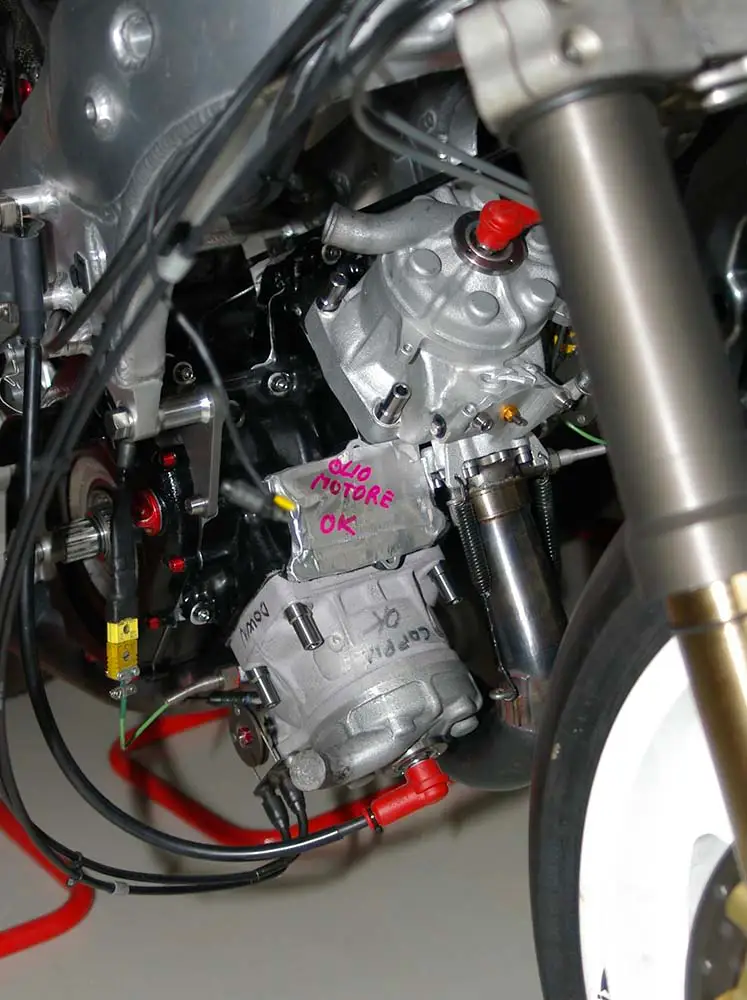
The 2005 250cc engine set up was a 90° 2 cylinders, with reed valve and two 40mm carburettors.
The Air Box
There were two air intakes on the side of the cowling, bringing fresh air to the two separated air boxes. After several tests made to study the configuration of the two separated air boxes, in order to obtain a similar functionality of the two cylinders, it hasn’t been possible to have 2 air boxes of the same dimensions, due to the overall dimensions.
Looking at the curves, you can see quite a regular output of power. In particular, a worsening of the power and torque curve is noticed due to the research of higher power in a lower range of use.
For this reason, during the 2006 season, a one-piece air box in Windform has been realized in order to exploit in the better way the space inside the frame with the front air intake under the lower triple clamp.
This allowed to reach a similar behaviour of the two cylinders, therefore making the setup of the engine easier. The engine has immediately improved and the setting of the two carburettors was similar.
A big success as there were no more difficulties with the fuel supply, different from cylinder to cylinder. The lower cylinder’s carburettor was very critical because the venturi first was too close to the side of the air box. The carburettor has therefore been rotated respecting the limits of the fuel level. Realizing a new structural (it means it supports the carburettor) induction insulator in Windform XT, it has been possible to improve the functionality of the cylinder n° 2.
With an increase in volume, a better geometry of the air box and a better positioning of the lower carburettor, a higher power and torque curve has been achieved, allowing the rider to exploit the engine already from low rpms.
Thanks to the mechanical wear resistance of CRP’s SLS material, it has been possible to realize the air box and over all the insulator directly in Windform shortening a lot the development and realization timing.
Diverse kind of insulators have been made and have been directly tested on the dyno until the best geometry was found. Holding the files, the “story” of the component can be preserved.
Cooling and Front Fender
Using an air box that exploits the whole space inside the frame, a big increase of power has been achieved. This increase is ruined by the engine’s temperature that reaches in a while 65-75°C with peaks of 75-80°C in the worse climatic conditions. These temperatures penalize the efficiency of the engine frustrating the job done on the air box.
To resolve this problem, a new front fender, whose function was also of an air conveyor, was created, exploiting the potentialities of the Rapid Prototyping.
It was realized in Windform XT and the idea was to bring fresh air to those “hidden” parts of the radiator to increase the engine’s cooling.
Exploiting the SLS technology and the Windform XT material it has been possible to realize the fender in a very short time and its use permitted to lower the temperature of 2 °C and had absolutely no side effect for assembling and dynamics.
Rear Fender
In order to optimise the air flux in the rear part of the bike, thus avoiding turbulences, a rear fender with two lateral fins to protect the swing arm was realized in Windform XT in a very short time. This part is really important to help the extraction of the hot air flux from the front and it has inside a duct for the rear braking oil pipe.
Fairing
The next step is to improve the cooling and the aerodynamics, in the penetration and the hot air extraction.
The air’s front entry of the R250GP fairings has increased in order to exploit the whole radiator and to facilitate the air’s entry.
Conclusion
In motorsport and automotive high performance, high quality and short time make the difference.
CRP worked hard to improve properties not only for functional testing models, but also for high-end prototypes and small lot production parts.
Windform family was born in 1998 with Windform GF (aluminium and glass filled), a compound later developed by other manufacturers too, and continued with Windform PRO and PRO B (aluminium and glass flakes filled; graphite filled).
The carbon fibre filled material branded Windform XT was launched in December 2004, and is the laser sintering powder with the higher mechanical and thermal properties compared to all powders for this technology. Then, in 2007 it has been launched the Windform FX, a new generation polyamide based material, in which mechanical and repeatable characteristics make it particularly suited for Rapid Manufacturing applications, that need of flexibility (e.i.: flexible components, functional parts with clicks or zips. In addition, ducts of a complex shape, with thin walls, particularly suited for aerospace and motorsport, dashboards and grids, fenders, fans and connectors).