

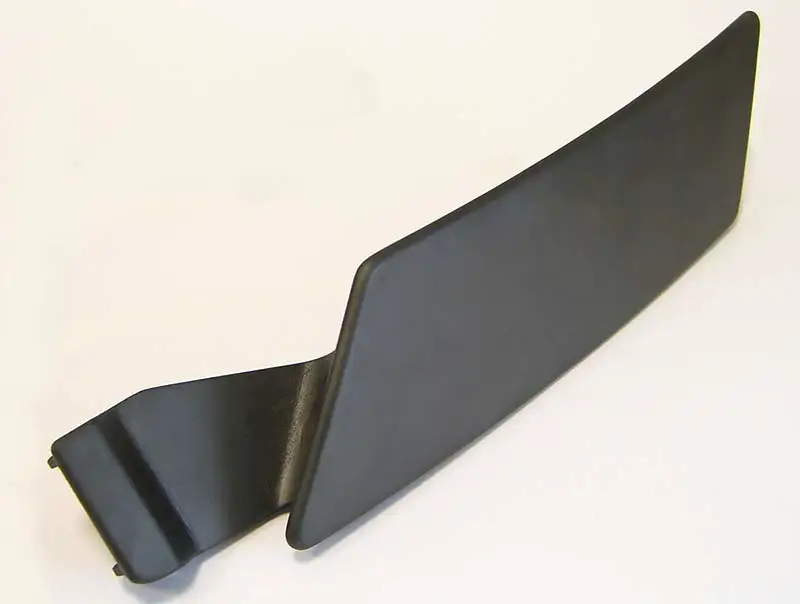
Thanks to 3D Printing Laser Sintering technology and Windform SLS materials it’s been achieved end use part, the Lamborghini Gallardo’s Headlight Washer Cover Flap, in number of 100 units for the pre-production models, respecting delivery timing as well as excellent surfaced finish and reliability features.
The materials for Laser Sintering available on the market until that moment didn’t reach the minimum mechanic and thermal properties that those application was requiring: once painted the part had to be fitted directly on the car.
Considering that the Gallardo can easily reach 300 km per hour and has to resist at every climatic condition, both in winter (-20°C) and in summer (+50/60°C), rain, hail, snow or sun, the challenge was very exciting.
Lamborghini team asked for a consulting and the suggestion was Laser Sintering and hi-performance Windform® materials. At the beginning of 2003 the most appropriate material was the Windform® PRO, aluminium and glass filled, granular and flat. The part has then been produced in Windform® XT, carbon fibre filled material: the tests made on the first and then on the second have underlined a good increase in performance with the carbon fibre filled, so we suppose that if at that time the carbon fiber filled material had been used, the performance would have been higher. Despite this, the Windform® PRO pieces didn’t have any problem.
The components made from injection moulding used previously weren’t suitable for this first phase.
For this reason the particular was still at a non-definitive definition and presented some showy defects, from project and process.
Once assembled in its closed position there was an evident discontinuity with the rest of the bodywork (hood, bumper and lateral body): the external surface had a different shape in respect to the hood and front headlight’s design.
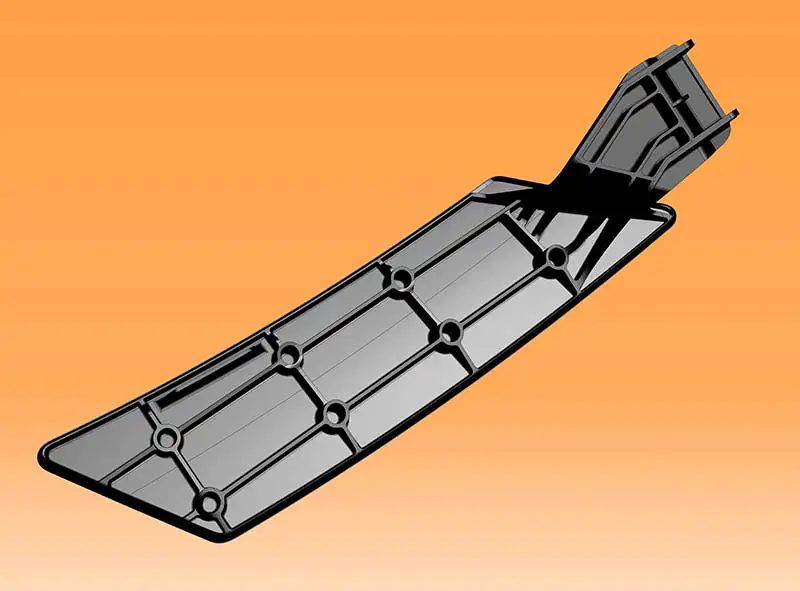
Moreover, in open position, the inner structure presented some imperfections due to shrinkage of the injection moulding causing defects also on the upper external part: the design was still not optimized for this kind of technology.
The first goal was to guarantee the reliability of the component through an increase in thickness in some particular points; some ribs were added close to the hinge of the cover flap. Consequently it has been corrected the shape of the external surface in cooperation with Lamborghini designers, in order to gain a perfect continuity in the area between the headlight, the hood and the headlight washer cover flap.

Once the co-engineering was finished, a first prototype was realized in a couple of days, useful for the company to check resistance through several different work cycles.

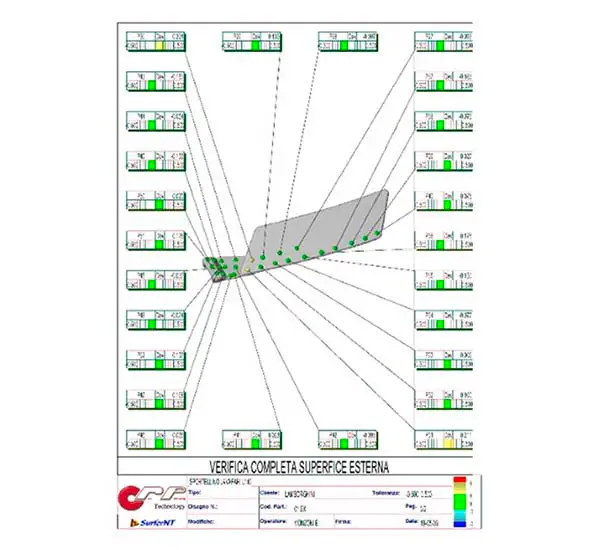
While this test was made a control mask was carried out to guarantee, within defined tolerances, that the component profile would follow perfectly the specific housing. A specific dimensional inspection, made through large reference points on each piece, standard operation in Formula one, would have excessively increase each component cost, this one being a large production part.
This inspection has been made therefore only for the very initial components to be tested and for the mask.
These new modifications had satisfied their requirement and the attention was then focused on the following problem.
The original particular had a shiny black colour, similar to the headlight’s one.
Lamborghini’s idea was to receive the particulars with already a primer on them, thus being able to paint them.
Their first painting test didn’t come up with positive results. In fact their internal paint shop did consider the sintered parts as if they were made of steel and therefore with some process at fairly too high temperature, causing deformation.
Later, the painting was made by a paint shop considering the correct temperature for Windform® PRO material and painting result was by then excellent.
Even the scratching test, performed to test pigmentation’s wear resistance in face of asperities at high speed, didn’t highlight any problem.
Once performed this last test, the remaining parts were finished and the first 100 cars were delivered with RP sintered components fitted. Thanks to the rapidity of laser sintering technology and to the material performance used for these parts, the delivery timing of the first cars were respected: in a couple of weeks the cover flap were sintered, superficially finished in order to have the minimum roughness for an excellent surfaced finish, painted and assembled on the conveyer.
Since today there are no claim or any minimum problem concerning these parts.